Superior Protection&Faster Decomposition & Cost Savings – Food-Grade Sustainable Packaging

How Colored Egg Carton Manufacturers Ensure Consistent Quality for Large-Volume Orders
31 Jul,2026
Due to the fact that the global food packaging sector is progressively going toward green alternatives, colored egg cartons have now been chosen as a favorable option among egg producers, food manufacturers, and retail brands owing to such carton properties as recyclability, biodegradability, and high protective features. When choosing a supplier, B2B customers engaged in long-term purchases pay special attention to consistency of quality offered by a supplier of colored egg cartons while ordering a large batch of cartons. The question that arises is how manufacturers of colored egg cartons provide consistency of the product in mass production.
Most colored egg cartons are made of environmentally friendly materials including recycled paper and waste pulp, which means that the quality of raw materials plays a significant role in such characteristics of the carton as strength, color uniformity, and molding features. Experienced manufacturers take care of stable supply of raw materials and check parameters, such as pulp fiber length, the level of impurities, and moisture.
The natural and environmentally friendly qualities of pulp materials mean that the colors may differ and the fibers may vary from batch to batch when producing recycled paper. As a result, manufacturers utilize pulp-blending technology to alter the ratio of raw materials to ensure that colored egg containers have uniform performance and appearance.
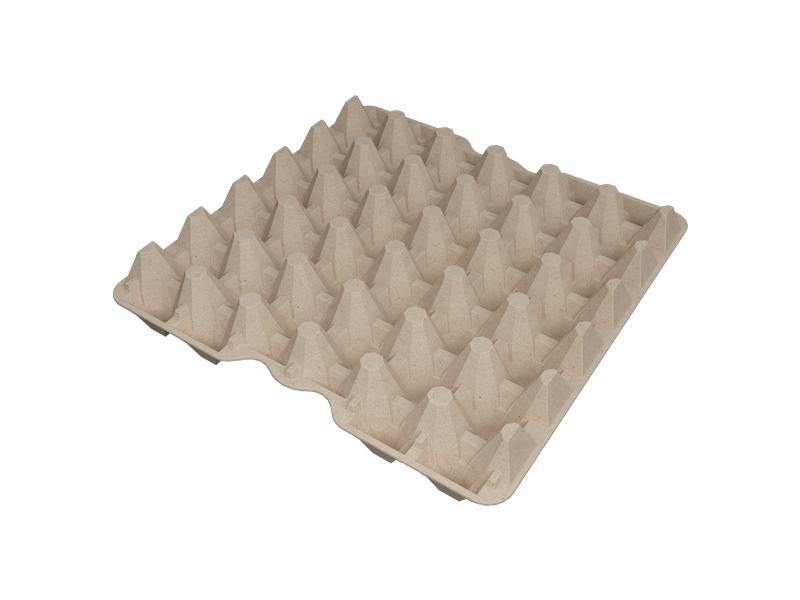
When producing in large quantities, manual work may create differences in the product’s properties, such as its size, weight, and strength. The trustworthy manufacturers of colored egg cartons usually work with automatic pulp forming lines that help obtain uniform products due to accurate control over the pulp amount, mold temperature, pressing time, and drying conditions.
Automatic machines not only help attain high productivity, but they also minimize quality variations associated with people who work with them.
Compared to standard pulp egg trays, colored pulp egg cartons demand higher standards for color stability. Manufacturers employ eco-friendly dyeing techniques—incorporating safe dyes evenly into the pulp rather than simply spraying the surface—to prevent issues such as color fading or noticeable color discrepancies.
Throughout the production process, manufacturers conduct random color inspections—monitoring shade, uniformity, and batch-to-batch consistency—to meet brand clients' requirements for visual uniformity in packaging.
To guarantee quality in large-volume deliveries, professional manufacturers implement quality inspection protocols at every stage of production. These include checking carton dimensions and structural integrity during the molding phase, monitoring moisture content during drying, and performing visual inspections prior to final packaging. Manufacturers also test the compression resistance, shock absorption, and stacking stability of the egg cartons to ensure they effectively protect the eggs during transport and storage, thereby minimizing breakage rates.
Demand for colored egg cartons varies across markets and clients regarding factors such as color, capacity, printed branding, and packaging style. Experienced manufacturers establish standardized production processes tailored to specific client orders, managing the entire workflow from mold development to mass production.
Manufacturers ensure consistent quality of their products by carefully keeping track of production specifications, batch numbers, and laboratory test results.
For businesses that are looking for suppliers of colored egg cartons, the most critical factors which impact the quality of the product include production capacity, raw material control system, and quality management system. Even though colored egg cartons made from recycled pulp are in line with the global movement toward greener packaging, meeting high-volume orders requires advanced production facilities and precise management. By cooperating with a supplier with automated production systems and strong quality control systems, companies can significantly minimize their procurement risks.
Recent Posts



Address: RM1605, Building B, Kailun International Mansion, Jinmalu, Dalian Economic Development Zone, Dalian City, Liaoning Province, 116000
E-mail: egg-pack@egg-pack.com
TEL: +86 18642767680

Chat